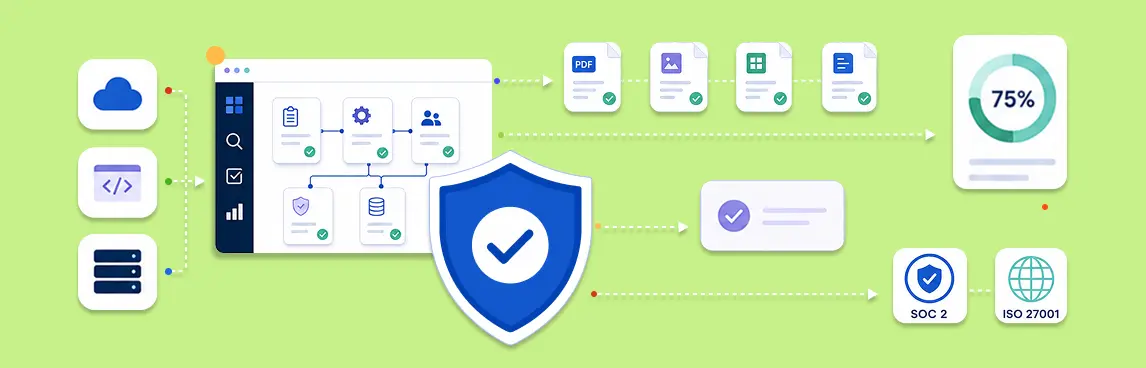
Continuous audit-readiness software should keep control requirements, operating procedures, evidence, owners, and reviewer decisions connected throughout the year. For SOC 2 and ISO 27001, the right system does more than collect screenshots. It shows what each control requires, where its evidence comes from, whether that evidence is current, who reviewed it, and what remains unresolved.
The buying decision comes down to four capabilities: reliable control mapping, multi-source evidence collection, honest readiness scoring, and a defensible reviewer workflow. Choose a product that can demonstrate all four with your own controls and data sources before you sign.
What Is Continuous Audit Readiness?
Continuous audit readiness is the operating state in which a company can explain its control environment and produce current, traceable evidence without launching a last-minute collection project. The goal is not to be “audit ready” according to a dashboard. The goal is to make the underlying control system reviewable at any point in time.
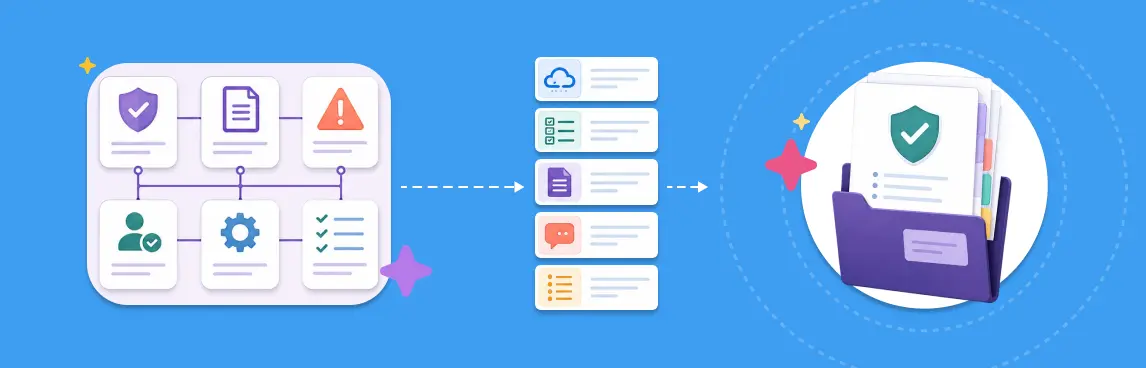
That requires three layers to agree:
- The requirement layer: frameworks, criteria, risks, and the controls selected to address them.
- The operating layer: policies, procedures, system configurations, tickets, approvals, and the people responsible for the work.
- The evidence layer: records that show the control was designed, performed, reviewed, and corrected when necessary.
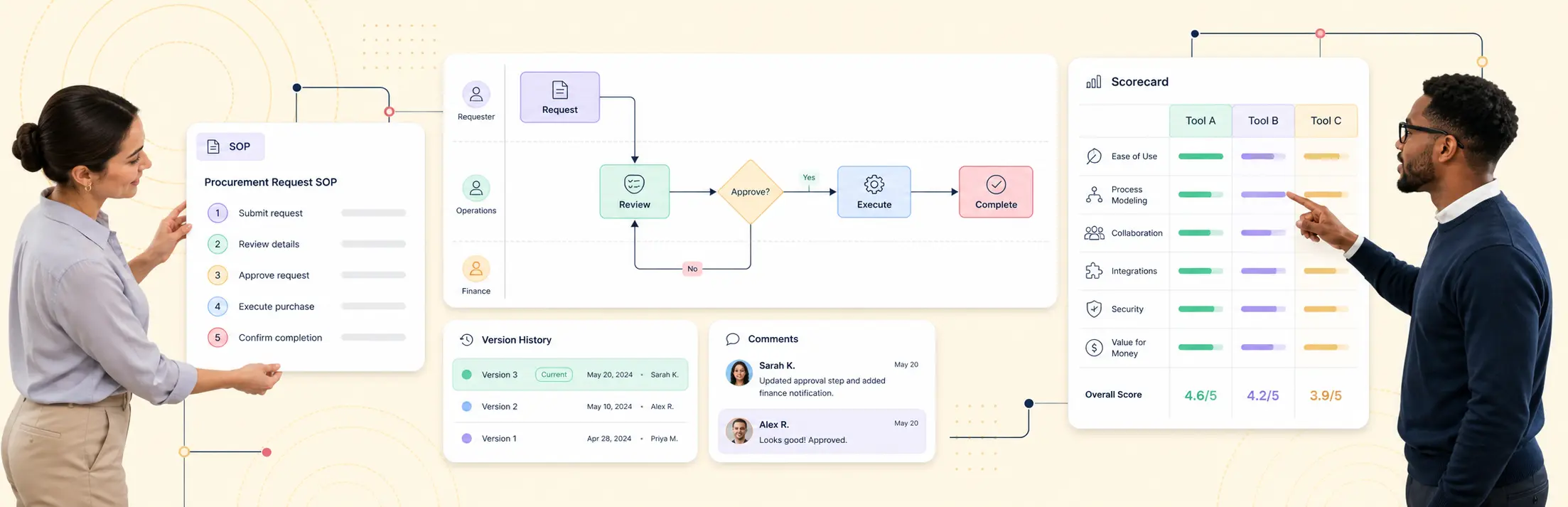
Teams that need to define the operating layer can use a process mapping guide to document control steps, decisions, and handoffs before connecting them to evidence. Creately’s process library also provides framework-based workflow references for compliance and operations teams.
The distinction matters. AWS states that its Audit Manager can automate the collection of relevant evidence, but it does not assess compliance and may not capture everything an audit requires. That is a useful buying principle for any platform: evidence automation supports assurance; it does not replace judgment. See the AWS Audit Manager documentation.
SOC 2 and ISO 27001: What the Software Must Model
SOC 2 and ISO 27001 overlap, but they are not interchangeable checklists.
For SOC 2, buyers need to connect controls and evidence to the applicable Trust Services Criteria and the system description. The system should help reviewers establish whether controls are suitably designed and, for a Type 2 engagement, whether they operated across the review period. Point-in-time screenshots are rarely enough for controls that run daily, monthly, quarterly, or on every change.
For ISO 27001, the system must support the information security management system, not only a list of technical safeguards. That means scope, risk assessment, risk treatment, selected controls, documented procedures, internal audits, management review, nonconformities, and corrective actions need traceable relationships. ISO describes ISO/IEC 27001 as the requirements standard for establishing, implementing, maintaining, and continually improving an ISMS. See the ISO overview of ISO/IEC 27001.
| Buying requirement | SOC 2 use | ISO 27001 use | What to verify in a demo |
|---|---|---|---|
| Control mapping | Map controls to applicable Trust Services Criteria | Map risks and controls to ISMS requirements and the selected control set | One control can map to multiple requirements without duplicating evidence |
| Evidence periods | Show operation across the audit period | Support monitoring, internal audit, and continual improvement cycles | Evidence has a source, timestamp, scope, owner, and validity window |
| Process documentation | Explain how controls operate in the system | Maintain controlled ISMS procedures and responsibilities | A procedure links to the live evidence that proves it is followed |
| Exceptions and actions | Record deviations, impact, and remediation | Track nonconformities and corrective actions | Findings retain decisions, owners, due dates, and closure evidence |
| Reviewer workflow | Support control-owner and auditor review | Support internal audit and management review | Approval history is immutable, attributable, and exportable |
The Eight Capabilities to Put on Your Shortlist
1. Many-to-Many Control Mapping
A mature control often satisfies several requirements across SOC 2, ISO 27001, customer questionnaires, and internal policy. Your software should map that shared control once and reuse its evidence without creating disconnected copies.
Ask the vendor to change a control and show what happens downstream. You should be able to see affected framework requirements, policies, tests, evidence requests, and open findings. If the product only exports a flat spreadsheet, the relationship model is too weak for continuous assurance.
2. Multi-Source Evidence Collection
Evidence lives in cloud services, identity providers, ticketing systems, code repositories, HR systems, policy documents, and conversations with control owners. No single connector covers the entire control environment.
Look for three collection modes:
- Automated technical evidence from supported systems.
- Referenced evidence that stays in its authoritative source.
- Structured manual evidence for procedural controls and judgment-based reviews.
AWS documents three automated evidence categories in Audit Manager: compliance checks, user activity, and configuration data. It also notes that collection frequency depends on the source; CloudTrail activity can be continual, while configuration snapshots can run daily, weekly, or monthly. This is why every evidence object needs provenance and freshness rules, not a generic “automated” badge. See how AWS Audit Manager collects evidence.
3. Evidence Freshness and Scope
The software should answer five questions for every artifact: What control does this support? Which systems, accounts, teams, or locations are in scope? When was it captured? For what period is it valid? What event should invalidate it?
A policy approved eleven months ago may still be valid. A user-access listing captured before a major reorganization may not be. Static expiration dates are useful, but event-driven invalidation is stronger.
4. Readiness and Gap Scoring You Can Explain
A single readiness percentage is convenient and potentially misleading. Buyers should demand a calculation they can inspect.
A credible score separates at least these states:
- Control not designed.
- Control designed but not implemented.
- Implemented with no evidence.
- Evidence present but stale, incomplete, or out of scope.
- Evidence awaiting review.
- Reviewed with an open exception.
- Reviewed and accepted for the stated period and scope.
The system should roll up those states without hiding critical exceptions inside an average. A 95% score should never obscure a failed privileged-access control.
5. Process and SOP Traceability
Technical collection tools are good at configurations and events. Auditors also ask how the work is supposed to happen and whether people followed that process.
Choose software that links policies to procedures, procedures to owners and systems, and each procedure step to evidence. A change-management control, for example, should connect the approved procedure to repository protection settings, sampled change tickets, approvals, deployment records, exceptions, and the reviewer’s conclusion.
The SOC 2 user access review process shows what this looks like for a quarterly control: the workflow, owner, applicable criteria, and evidence expectations stay together instead of being scattered across a policy, ticket queue, and spreadsheet.
This is the gap Creately Compass is designed to address. Compass complements Vanta and Drata rather than replacing them. It extracts and structures the process and SOP documentation teams otherwise maintain by hand, then graph-joins it to live cloud evidence so the written process and the operating environment can be examined together.
6. Reviewer Workflow and Separation of Duties
Collection is only the start. The system needs assigned reviewers, due dates, requests for clarification, sign-off, rejection, reopening, and a record of every decision.
Verify that a control owner cannot silently approve their own evidence when separation of duties is required. Ask whether reviewers can select samples, annotate individual artifacts, preserve superseded evidence, and export the reasoning behind a conclusion.
7. Exception and Corrective-Action Management
Real control environments contain exceptions. Good software makes them visible and manageable.
An exception record should include the affected control and scope, detection date, risk or impact, compensating measures, owner, target date, approval, remediation evidence, and closure decision. For ISO 27001, the workflow should also support nonconformity and corrective-action records without forcing them into a generic task list.
8. Auditor-Ready Exports and Access
Your auditor should be able to review a coherent package without learning the product’s internal taxonomy. Exports should preserve control mappings, evidence indexes, timestamps, sources, review history, exceptions, and attachments.
Ask whether you can grant time-bound, read-only access. Confirm that the export remains intelligible outside the platform and that links do not break when the engagement ends.
A Practical Vendor Evaluation Scorecard
Score each category from 0 to 3: 0 means absent, 1 means manual or partial, 2 means usable with limitations, and 3 means demonstrated end to end with your data.
| Category | Weight | Pass condition |
|---|---|---|
| Control and framework mapping | 20% | Reusable controls with traceable many-to-many mappings |
| Evidence coverage and provenance | 20% | Automated, referenced, and manual evidence with source and scope |
| Process and SOP traceability | 15% | Written procedures connect directly to operating evidence |
| Readiness and gap logic | 15% | Scores expose missing, stale, unreviewed, and excepted evidence |
| Review and approval workflow | 10% | Attributable decisions, separation of duties, and reopening |
| Exceptions and corrective actions | 10% | Findings remain connected through verified closure |
| Export, retention, and access | 10% | Complete, portable audit package and controlled auditor access |
Do not let connector count dominate the evaluation. A product with 200 connectors can still leave process evidence, scoping decisions, and reviewer conclusions in documents and spreadsheets.
Questions to Ask During a Product Demo
Use one real control and follow it from requirement to audit package.
- Show how this control maps to both SOC 2 and ISO 27001 without duplicating it.
- Show the policy and procedure that define how the control operates.
- Collect evidence from two technical systems and one manual process.
- Change the control’s scope and show which evidence becomes invalid.
- Show how the readiness score changes when evidence is stale or rejected.
- Assign an independent reviewer and record a request for clarification.
- Open an exception, approve a compensating measure, and verify closure.
- Export the complete control record for an auditor.
- Show every action in the audit trail, including configuration changes.
- Explain what the platform does not automate.
The last question is revealing. Credible vendors distinguish evidence collection from compliance judgment.
For a deeper test of source coverage, use Federated Control Evidence: Proving Coverage Across Process and Cloud. It explains how procedures, approvals, tickets, and live cloud facts connect to the same control claim.
Red Flags When Comparing Audit-Readiness Platforms
- A readiness score with no inspectable formula. You cannot defend a number if you cannot explain its inputs.
- Framework templates treated as universal control designs. Your scope, risks, systems, and procedures determine what is appropriate.
- Evidence with no validity period or system scope. A file is not useful proof merely because it is attached to a control.
- No link between procedures and live systems. This recreates the exact documentation gap continuous readiness should close.
- Bulk approval without reviewer accountability. Fast sign-off is not strong assurance.
- Exports that omit review history or exceptions. The audit package should preserve how conclusions were reached.
- Claims that automation guarantees certification or a clean opinion. Software assists the program; auditors and certification bodies reach assurance conclusions.
Where Creately Compass Fits
Creately Compass is an enterprise compliance assurance layer for CISOs, GRC teams, and compliance consultants. It is designed for the space between control-automation platforms and the process documentation auditors still need.
Compass structures policies, processes, and SOPs, then connects them to evidence from multiple systems from live cloud environments. The resulting graph lets a reviewer follow a requirement to its control, procedure, system evidence, owner, and exception history. That makes inconsistencies visible: a policy may require one approval path while the actual cloud or development workflow follows another.
Use Compass alongside Vanta or Drata when those systems remain the control-automation hub but the team needs stronger process evidence and cross-source traceability. Evaluate it with the same scorecard above. The relevant test is not how polished the dashboard looks. It is whether the system can prove coverage across the complete control story.
How to Choose the Right Continuous Audit-Readiness Software
Start with your assurance model, not a vendor feature list. Select five representative controls: one automated technical control, one identity control, one change-management control, one people-process control, and one control with a known exception. Define the scope, expected evidence, frequency, reviewer, and failure conditions for each.
For a worked implementation sequence, use SOC 2 Readiness: From Control Framework to Evidence Pack. It shows how to turn mapped controls, procedures, source evidence, reviews, and exceptions into a portable audit handoff.
Then run every shortlisted platform through the same proof of concept. The winner should reduce collection effort while making gaps more visible, not less. It should preserve the connections among requirements, procedures, live evidence, and human decisions. That is what turns compliance activity into continuous audit readiness.