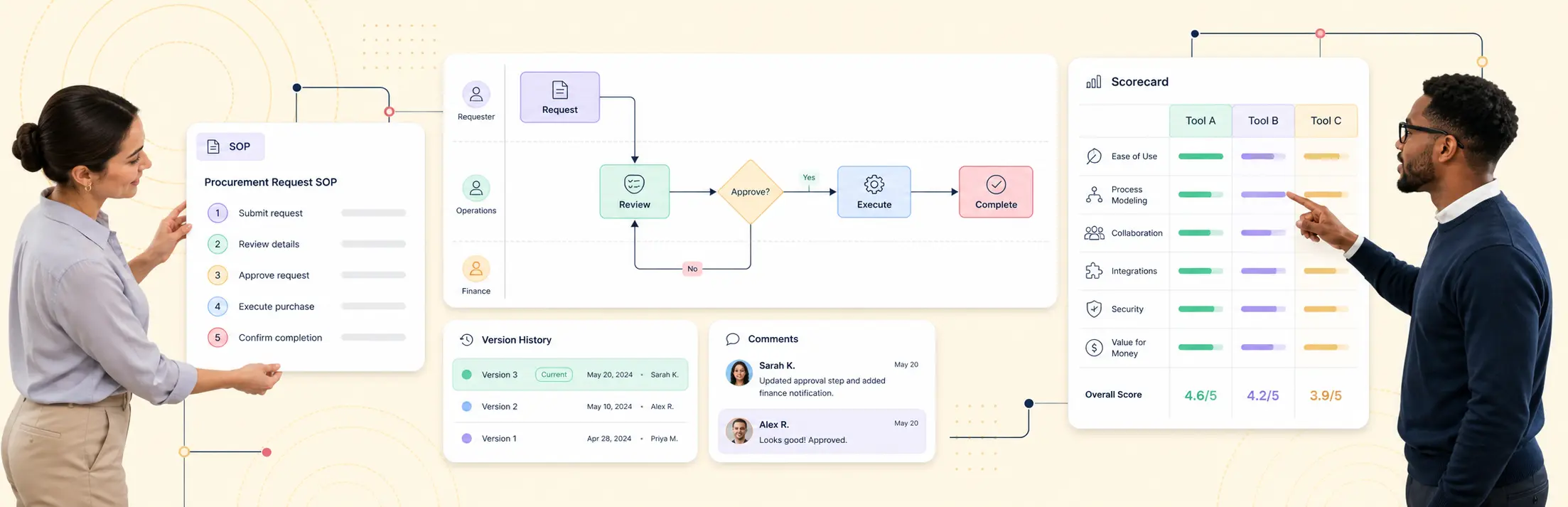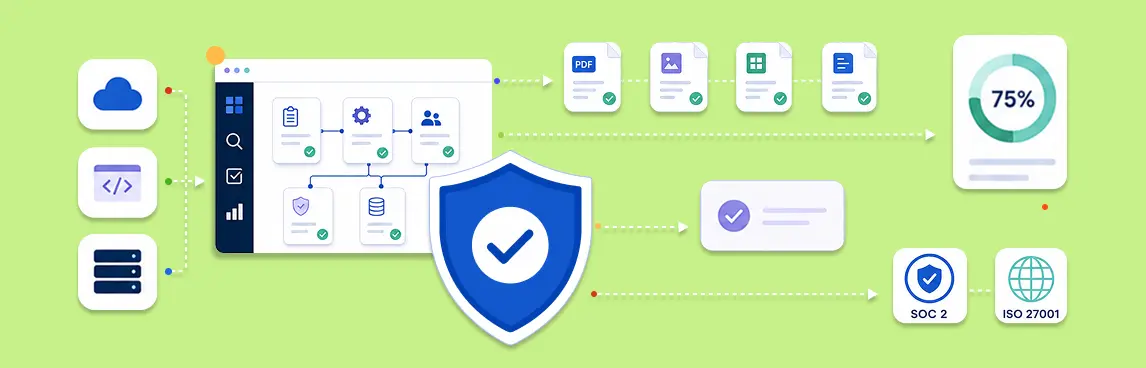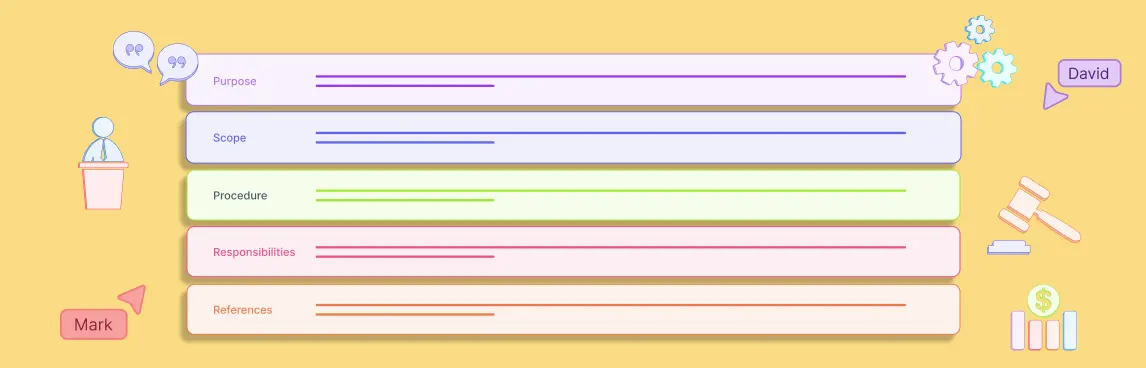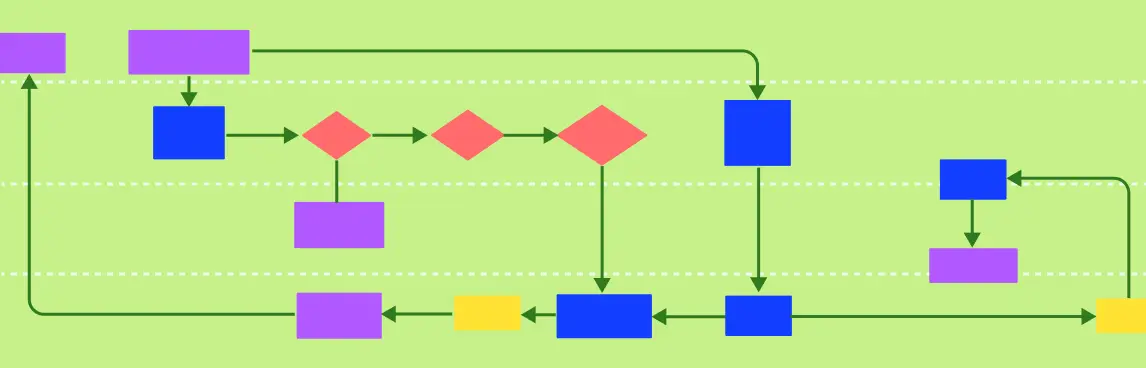
Process documentation supports audit evidence when each control claim connects to an approved procedure, accountable owner, effective version, operating records, and reviewer conclusion. Creately Process models how the control should operate. Creately Compass connects that model to requirements, controls, live evidence, exceptions, and review decisions.
An SOP alone does not prove operating effectiveness. It supports control design. The evidence set must also show what happened, across which systems and period, who reviewed it, and how deviations were handled.
The Evidence Chain Auditors Need
A defensible evidence chain lets a reviewer move from a requirement to a conclusion without reconstructing the story from filenames and screenshots.
| Evidence layer | Question it answers | Typical objects |
|---|---|---|
| Requirement | Why is the control needed? | Framework clause, contract, policy, risk, or regulation |
| Control claim | What must be true? | Control objective, activity, frequency, scope, and owner |
| Process design | How should the control operate? | Process map, SOP, decision rules, roles, and exceptions |
| Execution record | What actually happened? | Ticket, approval, log, report, attestation, or configuration |
| Evaluation | Is the evidence relevant and sufficient? | Test procedure, sample, reviewer note, exception, or finding |
| Conclusion | What did the reviewer determine? | Effective, ineffective, inconclusive, accepted exception, or remediation required |
Missing links create predictable audit questions. A policy with no procedure does not explain implementation. A cloud snapshot with no scope or control mapping does not show why it matters. An approval with no source record does not prove what was approved.
Process Evidence and Technical Evidence Prove Different Things
Process evidence explains the operating method. Technical evidence records system state or activity. Most controls require both.
Consider a production change-management control:
- The approved procedure defines request, risk review, approval, deployment, validation, and exception steps.
- Role assignments identify who can request, approve, deploy, and independently review a change.
- Pull requests, tickets, pipeline events, and cloud activity show specific changes moving through the process.
- Configuration evidence shows the resulting production state.
- A reviewer compares the sample to the control claim and records exceptions.
AWS states that Audit Manager helps collect evidence relevant to verifying compliance but does not assess compliance itself, and its collected evidence might not contain everything an audit needs. That distinction applies beyond AWS: collection supports judgment; it does not replace it. See What is AWS Audit Manager?.
Start with a Testable Control Claim
A good control claim is specific enough to test. It defines the expected activity, owner, population, frequency, and outcome.
Weak claim:
Production changes are approved.
Testable claim:
Every production infrastructure change is linked to an authorized request, approved by a role independent of deployment, released through the controlled pipeline, and verified against the intended configuration.
The second version reveals the process steps and evidence sources required. It also exposes what an exception looks like.
Document these fields before collecting evidence:
- Control purpose and related requirement.
- In-scope business units, systems, accounts, and resource populations.
- Accountable control owner and operating roles.
- Trigger or operating frequency.
- Expected procedure and decision criteria.
- Required evidence for each part of the claim.
- Reviewer, sampling method, and conclusion rules.
- Exception, escalation, and remediation path.
Model the Procedure in Creately Process
Creately Process is the operating-model layer. Ops, Quality, and Business Analysts can document and govern workflows from accessible process maps to formal BPMN in one workspace.
Model enough detail to make the control executable and testable:
- Identify the start event or trigger.
- Show the required tasks and their sequence.
- Assign responsible and accountable roles.
- Define decision criteria and approval boundaries.
- Show systems, forms, and records used at each step.
- Include exception and escalation paths.
- Connect shared subprocesses rather than copying them.
- Publish a controlled version with an effective date and review cycle.
Use formal BPMN when event semantics, messages, gateways, or system handoffs need precision. Use a simpler process map when the primary job is operational communication. The model should stay connected to the same governed process rather than splitting into unrelated diagrams.
Teams still consolidating files can use the living process repository migration playbook to establish ownership, version control, and review rules before mapping evidence.
Map Procedure Steps to Controls and Evidence
Map evidence to the specific part of the control claim it supports. A folder labeled “Access Review Q2” is not enough.
| Procedure step | Control assertion | Evidence source | Required context |
|---|---|---|---|
| Generate user population | Review covers all in-scope accounts | Identity-provider export or query | Tenant, filters, timestamp, account count, and source ID |
| Assign reviewers | Qualified owners review relevant access | Role and system-owner assignments | Effective roles, assignment date, and scope |
| Record decisions | Each account receives a decision | Review workflow or approval record | Reviewer identity, decision, time, and rationale |
| Remove access | Rejected access is revoked | Ticket and identity event | User, entitlement, due date, completion, and event ID |
| Verify completion | Independent reviewer checks closure | Sign-off and exception register | Sample or population, findings, reviewer, and conclusion |
One evidence object may support several controls. Keep one authoritative object and map it to each relevant claim rather than uploading disconnected copies.
Preserve Provenance and Freshness
Evidence is trustworthy when its origin and limits remain visible.
Capture at least:
- Authoritative system and stable object identifier.
- Collection method, such as API, event, query, export, reference, or upload.
- Capture time and period covered.
- Accounts, systems, people, locations, and populations in scope.
- Hash, version, immutable event ID, or other integrity context when available.
- Related control, procedure step, and requirement.
- Owner, reviewer, and evaluation state.
- Freshness rule or invalidating event.
- Exceptions, exclusions, and known limitations.
AWS Audit Manager distinguishes inconclusive evidence from failure when automated evaluation is unavailable. Inconclusive evidence requires manual evaluation. See how AWS Audit Manager collects evidence. A useful assurance model should preserve similar distinctions instead of converting every uncertain result into a green or red status.
Evaluate Evidence, Not Attachment Counts
More files do not mean stronger assurance. Review evidence against explicit assessment objectives.
NIST SP 800-53A Revision 5 provides a methodology and customizable procedures for assessing security and privacy controls within a risk-management framework. It also addresses assessment planning and analysis of results. See NIST SP 800-53A Revision 5.
For each control, evaluate:
- Relevance: Does the evidence address the claim being tested?
- Scope: Does it cover the required systems, population, and locations?
- Period: Does it support the operating frequency and assessment window?
- Reliability: Is the source authoritative and the record protected from silent alteration?
- Completeness: Are all required steps, decisions, and exceptions represented?
- Consistency: Do process documentation, tickets, approvals, and technical state agree?
- Reviewability: Can another qualified reviewer follow the relationship and reproduce the conclusion?
Record missing, stale, inconclusive, rejected, excepted, and superseded evidence as different states. They require different responses.
Move from Creately Process to Creately Compass
Creately Compass is the assurance layer. It connects the governed procedures built in Creately Process to requirements, controls, live cloud evidence, owners, reviews, and findings.
| Product | Primary responsibility | Assurance contribution |
|---|---|---|
| Creately Process | Model and govern how work operates | Procedures, roles, decisions, handoffs, exceptions, and effective versions |
| Creately Compass | Evaluate whether documented controls match evidence | Requirements, control mappings, evidence relationships, coverage, reviews, findings, and exports |
The handoff should preserve relationships:
- A control links to its effective procedure in Creately Process.
- Procedure steps link to evidence requirements and authoritative sources.
- Creately Compass joins the process context to live or referenced evidence.
- Coverage checks expose missing, stale, or contradictory relationships.
- Reviewers record conclusions, exceptions, and remediation work.
- The exported readiness record preserves provenance and review context.
Compass complements Vanta and Drata; it does not replace them. Teams can retain their compliance-automation platform while using Compass to structure the process and SOP layer, then connect that context to live cloud evidence.
The federated control evidence guide explains the assurance-graph model for joining process and cloud sources without copying every record into one platform.
Build an Audit-Ready Evidence Pack
An evidence pack should preserve the reasoning behind the conclusion, not just provide a compressed folder.
Include:
- Assessment scope, period, framework, and applicable requirements.
- Control statement, owner, frequency, and expected outcome.
- Effective process or SOP version and approval history.
- Evidence index with source, scope, period, and control mappings.
- Test procedure, sample selection, and reviewer work.
- Exceptions, impact decisions, compensating controls, and remediation.
- Final conclusion and reviewer sign-off.
- Change history for material updates during the assessment period.
ISO 19011:2026 provides current international guidance for auditing management systems, including audit principles, program management, conducting audits, and auditor competence. See ISO 19011:2026.
The SOC 2 readiness evidence-pack guide provides a fuller structure for packaging controls, evidence, findings, and reviewer context for handoff.
Questions to Test the Process-to-Evidence Design
- Can a reviewer move from a requirement to a control, effective procedure, evidence, test, and conclusion?
- Does every control identify its owner, scope, frequency, and expected outcome?
- Is the currently effective procedure distinguishable from drafts and superseded versions?
- Does each evidence object retain its authoritative source and stable identifier?
- Can one evidence object support several controls without being copied?
- Do scope or configuration changes invalidate affected evidence?
- Are process exceptions linked to technical findings and remediation?
- Can the model distinguish missing, stale, inconclusive, rejected, and excepted evidence?
- Does reviewer sign-off preserve the test method and reasoning?
- Can an export retain relationships outside the platform?
If reviewers must infer these relationships from filenames, the system is storing artifacts rather than managing assurance.
Where to Start
Choose one control that crosses process and technical systems. Change management, access review, vulnerability remediation, and incident response are useful candidates.
Model the procedure in Creately Process. Define a testable control claim. Connect each step to the evidence it should produce. Then use Creately Compass to map requirements, assess coverage, review exceptions, and preserve the conclusion.
The process management software buyer’s guide offers evaluation criteria for repositories, ownership, versioning, BPMN, and evidence support. The safest existing operational pathway is Creately’s process mapping software, which lets teams assess the modeling foundation without inventing an undefined conversion step.
FAQs About Process Documentation for Audit Evidence
Is process documentation itself audit evidence?
Can automated cloud evidence replace SOP evidence?
Should evidence be copied into Creately Compass?
How often should process evidence be reviewed?
What makes an evidence set audit ready?